Land-Clearing Costs
How Much Does Land Clearing Cost in Tennessee?
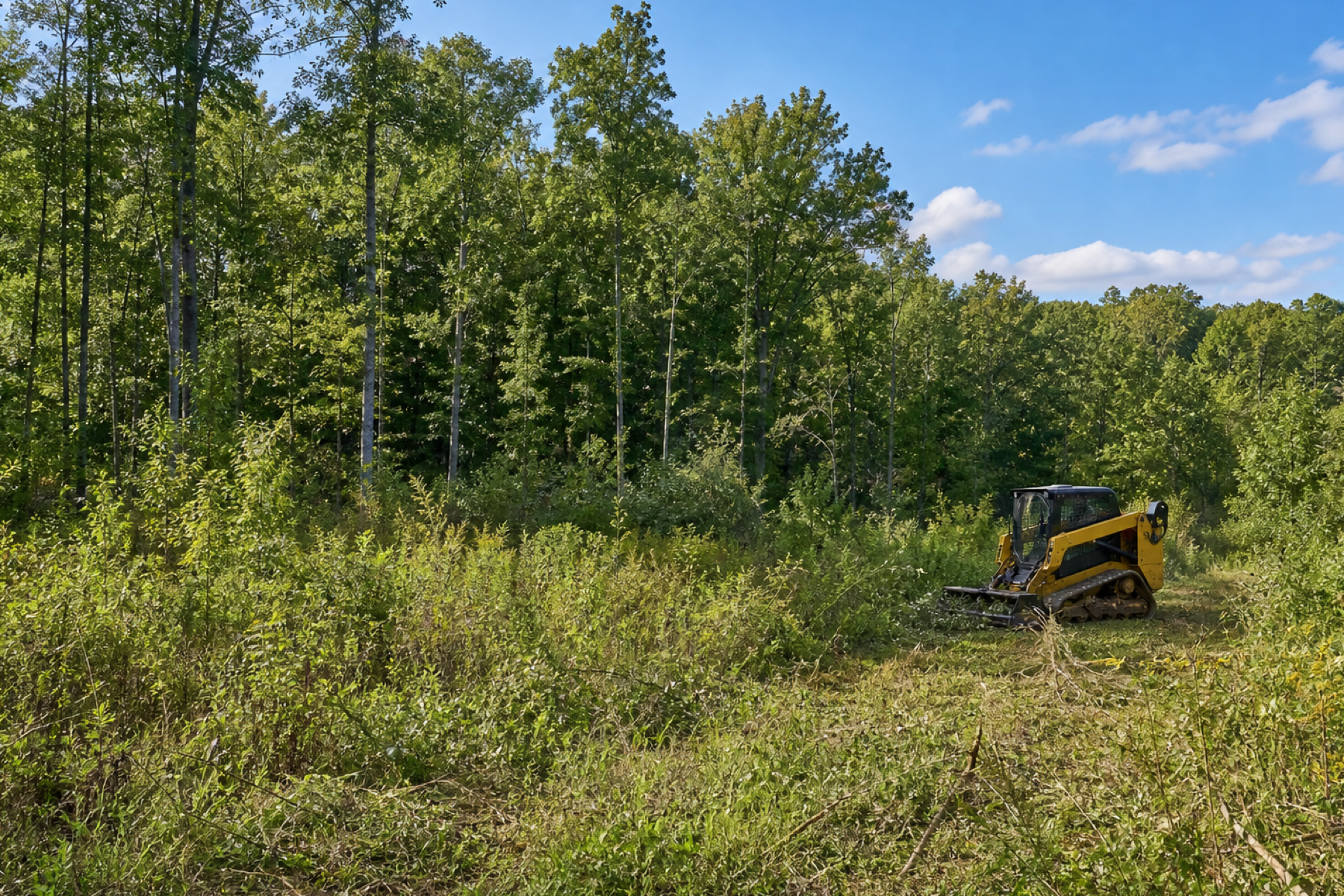
It's the first question almost everyone asks, and the honest answer frustrates people at first: land clearing in Tennessee doesn't have a single per-acre price. A flat, open acre of light brush and a steep, wooded acre full of mature hardwoods and buried stumps are the same size and completely different jobs — sometimes by a factor of several.
What this guide does is show you the factors that actually move a clearing estimate up or down, so the numbers make sense when a contractor gives them to you, and so you know which details about your property are worth describing when you request a review.
Why Acreage Alone Doesn't Set the Price
A per-acre figure feels like it should exist, but it's misleading because acreage measures area, not the work inside that area. The real cost is driven by how much material has to be cut, ground, or hauled, how hard the machines have to work to do it, and what condition the ground has to be left in. Two ten-acre parcels can differ enormously on all three.
That's why any contractor who quotes a firm price sight-unseen is either padding it to cover the unknowns or setting up an 'adjustment' once the work starts. A property review — ideally with photos — is what turns a guess into a real number.
The Factors That Actually Drive the Estimate
- Vegetation density — walkable woods versus an impenetrable wall of brush and vines change production speed dramatically.
- Tree size and species — saplings a mulcher shreds in seconds are a different job than mature hardwoods that must be felled and handled.
- Terrain — flat creek-bottom ground is fast; slopes, rock, and soft spots slow machines and limit what can be used.
- Access — gate width, overhead clearance, and how far equipment must travel to reach the work area all matter.
- Stumps and roots — leaving them is cheaper; grubbing them out for construction adds a whole phase.
- Debris handling — mulching in place is usually most economical; piling, burning where permitted, or hauling off-site adds cost.
- Finished condition — 'knocked back' brush is one thing; a graded, build-ready pad is another.
Forestry Mulching Often Changes the Math
One reason the 'cost per acre' question misleads is that the method matters as much as the acreage. Forestry mulching grinds standing brush and small trees into a layer of mulch in a single pass with one machine, leaving no debris to haul — which often makes it the most economical approach for brush, saplings, and light woods.
Traditional clearing (dozer or excavator work, plus debris handling) can be necessary for large trees, stump removal, or construction prep, and it carries the added cost of dealing with what's pushed out. Matching the method to the property is a big part of what a contractor's evaluation is for — see our guide on forestry mulching versus traditional clearing.
How to Get a Real Number for Your Property
The fastest route to an accurate estimate is a request that lets a contractor picture the job: the property location or nearest road, an acreage estimate, a description of the vegetation and tree sizes, notes on terrain and access, what you want the finished land used for, and — most valuable of all — several wide-angle photos.
With that, a contractor can size the equipment and scope the work before ever driving out, and the estimate conversation gets far shorter. Our guide on what property photos to send walks through exactly what to capture.
Helpful Guides
This guide is general information for property owners and does not replace an on-site evaluation. Upper Cumberland Land Clearing is an independent referral service; project scope, methods, equipment, pricing and scheduling are determined by the contractor who reviews your property.
Land-Clearing Costs Questions
Not a reliable one. Per-acre averages you find online blend together wildly different jobs — light brush mulching and heavy wooded clearing with stump removal — so they rarely match a specific property. The factors that matter (vegetation, tree size, terrain, access, stumps, debris, and finished condition) vary too much for a single number to be useful.
Usually heavy tree cover with large-diameter hardwoods, the need to remove stumps and roots, difficult terrain or access, and a requirement to haul debris off-site rather than mulch it in place. Any one of those raises the scope; several together can multiply it.
Often, for the right conditions — brush, saplings, and light-to-medium woods — because it's a single machine, a single pass, and no debris to haul. For large trees, stump removal, or construction prep, traditional methods may be necessary and cost more. The property determines which fits.
Be clear about what actually needs clearing (selective clearing costs less than clearing everything), leave stumps if the land use allows it, choose in-place mulching over hauling when possible, and provide good photos and access details so the estimate is accurate and the crew works efficiently.
Because the price depends on things they can't see without the property — tree sizes, density, terrain, access, and the finished condition you need. A good contractor will give a realistic range from photos and details, then confirm on site.
Ready to Turn Overgrown Land Into Usable Property?
Share your contact details and you’ll be contacted to discuss where the property is, how much land is involved and what needs to be cleared.