Land-Clearing Costs
Forestry Mulching Cost Versus Traditional Clearing
When people compare land-clearing quotes, they're often really comparing two different methods without realizing it. Forestry mulching and traditional clearing produce different results, involve different equipment, and — importantly — have different cost structures. Understanding why helps you read quotes correctly.
This guide explains what drives the cost of each approach and where each one tends to be the economical choice, so you can tell whether a lower quote is actually a better deal or just a lighter scope.
Why Forestry Mulching Is Often Cheaper
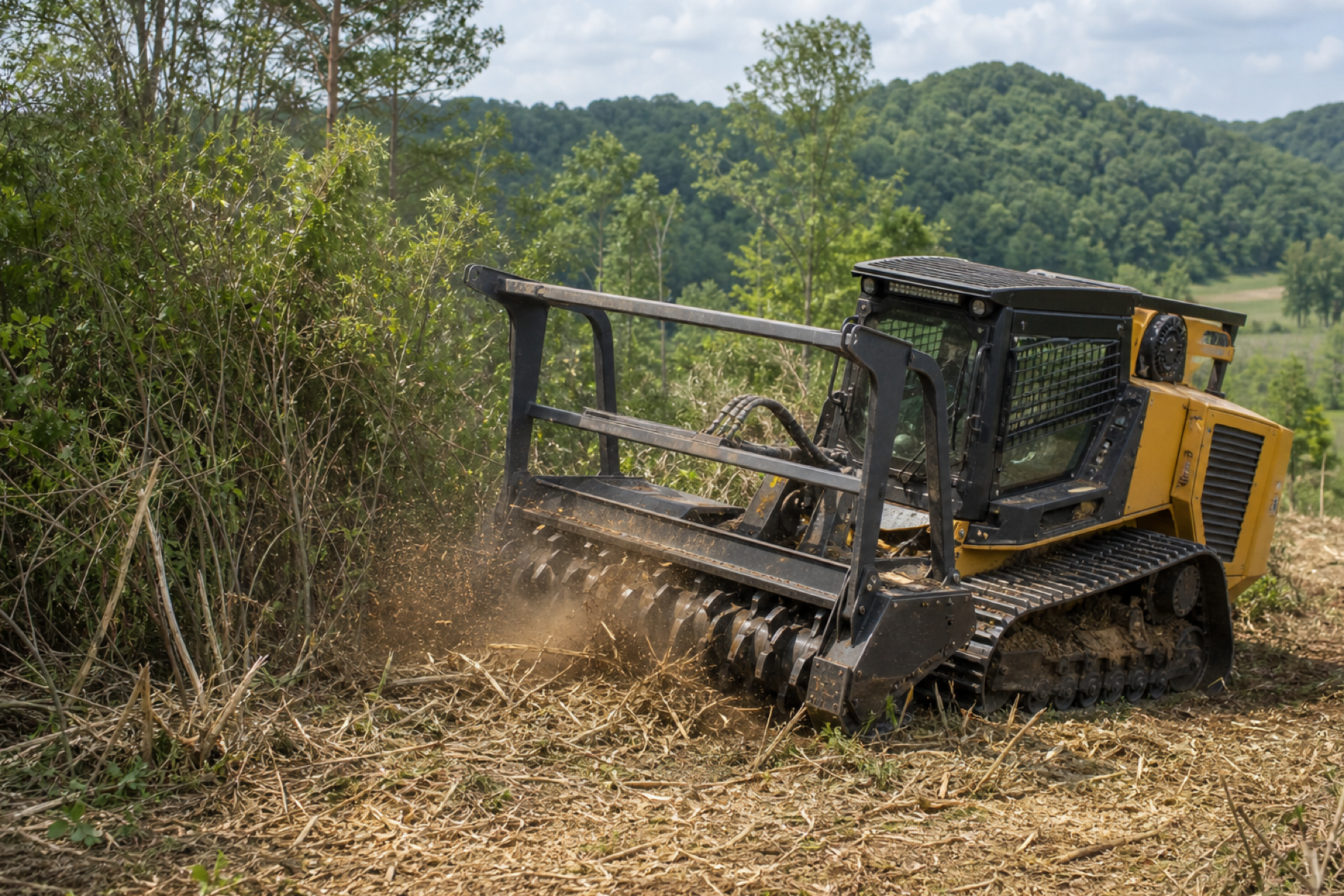
Forestry mulching does the whole job with one machine in one pass: a mulching head grinds standing brush and small trees into a layer of mulch that stays on the ground. There's no felling-then-handling sequence, no piling, and — the big one — nothing to haul away. Removing debris hauling from the equation is where much of the savings comes from, because hauling means trucks, trips, disposal, and time.
It's also low-impact: the mulch layer protects the soil surface and there's minimal ground disturbance, which can save on erosion control and cleanup later.
Where Mulching's Cost Advantage Ends
Mulching has limits, and past them the cost advantage disappears. Large-diameter trees are slow or impossible for a mulcher and are better felled and handled traditionally. Anything below the surface — stumps, roots, rock — is outside what a mulcher does, so construction prep that requires grubbing needs traditional equipment. And mulching leaves the material on-site; if you specifically need bare, cleared ground with everything removed, that's a different job.
What Traditional Clearing Buys
- The ability to remove large trees, stumps, and roots completely.
- Bare, graded ground ready for construction rather than a mulched surface.
- Handling of material that has to leave the property.
- Site shaping — grading, drainage, and pad prep — that mulching doesn't touch.
Reading a Quote: Method vs. Price
A cheaper quote isn't automatically the better value if it's for a lighter scope. Before comparing two numbers, confirm what each covers: mulching in place versus full clearing with debris removal, stumps left versus grubbed, surface finish versus graded pad. Two honest quotes can look far apart simply because they describe different work.
The most cost-effective real answer is usually a mix matched to the property — mulch the brush and light woods, handle the few big trees and the building footprint traditionally. That matching is exactly what a contractor's property review determines.
Helpful Guides
This guide is general information for property owners and does not replace an on-site evaluation. Upper Cumberland Land Clearing is an independent referral service; project scope, methods, equipment, pricing and scheduling are determined by the contractor who reviews your property.
Land-Clearing Costs Questions
No — it's usually cheaper for brush, saplings, and light-to-medium woods because it's one machine, one pass, and no hauling. For large trees, stump removal, or construction-ready bare ground, traditional methods are often necessary and cost more. The conditions decide.
Hauling means loading, trucking, trips back and forth, and disposal — time and equipment that in-place mulching avoids entirely. On many jobs, eliminating the haul is the single biggest cost difference between the two methods.
Mulching can clear the standing vegetation, but a building site usually also needs stumps and roots removed and the ground graded — work mulching doesn't do. Many home-site projects mulch first, then bring in traditional equipment for grubbing and grading.
Describe what's standing (brush, saplings, or big timber), the terrain, and what you want the finished land used for. A contractor matches the method — often a combination — to those conditions during the property review.
Ready to Turn Overgrown Land Into Usable Property?
Share your contact details and you’ll be contacted to discuss where the property is, how much land is involved and what needs to be cleared.