Clearing Methods
Forestry Mulching Versus Traditional Land Clearing
Forestry mulching and traditional land clearing are the two broad approaches to opening up wooded or overgrown land, and they produce genuinely different results. Choosing well starts with understanding what each one actually does to the property — not just what it removes, but what it leaves behind.
This guide compares the two on method, result, and best fit, so you can tell which suits your goals — or whether, as is often the case, the right answer is a combination.
What Forestry Mulching Does
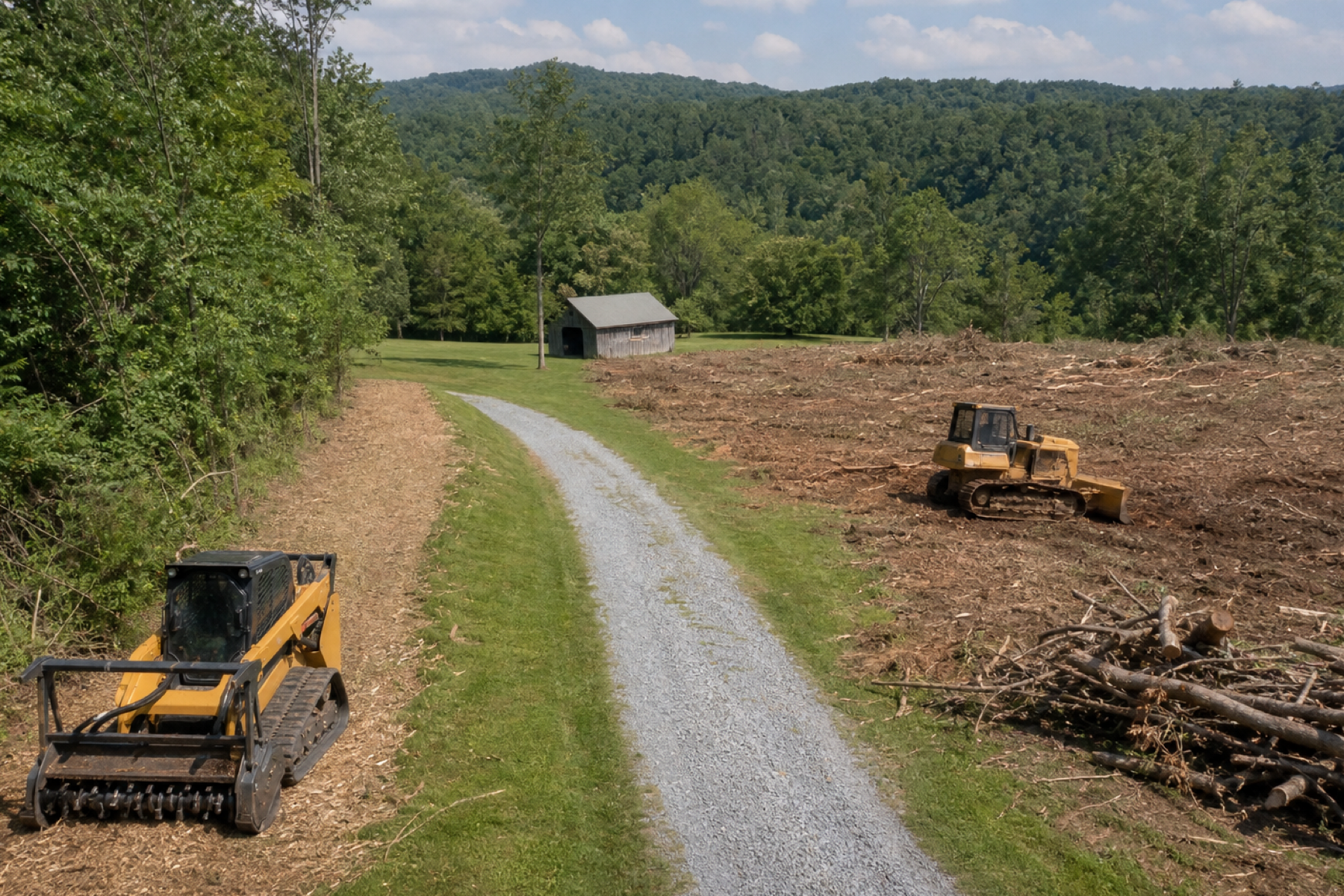
A forestry mulcher is a single tracked machine with a rotating drum of teeth that grinds standing brush, saplings, and small-to-medium trees into mulch on the spot. It works top-down, reducing vegetation to a layer of wood chips that stays on the ground as a protective, decomposing cover.
The result is a cleared surface with the soil largely undisturbed, no piles, and nothing to haul. Stumps remain in the ground, ground-level or slightly below, so the land is open and usable but not stripped bare.
What Traditional Clearing Does
Traditional clearing uses dozers, excavators, and similar equipment to push over, dig out, and remove vegetation — often including stumps and roots. The material is gathered and dealt with by piling, burning where permitted, or hauling off-site. Grading and site shaping can be part of the same effort.
The result is bare, worked ground that can be taken all the way to a construction-ready state. It's more thorough and more disruptive to the soil surface, and it involves handling everything that's removed.
Which Fits Which Goal
- Reclaiming pasture, opening woods, clearing brush and saplings, low-impact work → forestry mulching usually fits.
- Preparing a building site, driveway, or pond → traditional clearing, often with grubbing and grading.
- Removing large trees or stumps → traditional methods.
- Keeping the soil surface protected and avoiding debris → mulching.
- Needing bare, graded, build-ready ground → traditional clearing.
Why the Answer Is Often 'Both'
In practice, many projects use both. A contractor might mulch the brush and light woods across a parcel, then bring in an excavator to remove the handful of large trees and grub the building footprint. This matches each tool to the part of the job it does best and usually lands on the most cost-effective result.
The decision isn't really 'which method' in the abstract — it's 'what does this property need to become, and what mix of methods gets it there.' That's what a property review answers.
Helpful Guides
This guide is general information for property owners and does not replace an on-site evaluation. Upper Cumberland Land Clearing is an independent referral service; project scope, methods, equipment, pricing and scheduling are determined by the contractor who reviews your property.
Clearing Methods Questions
A layer of wood-chip mulch from the ground-up vegetation, with stumps remaining in place at or near ground level. The soil surface stays largely intact, and there are no piles or debris to remove. The mulch decomposes over time and helps protect against erosion.
No. Mulching processes vegetation from the top down and leaves stumps in the ground. If your project needs stumps gone — typically for construction — that's a separate operation using traditional equipment.
Neither is better in general — they do different things. Traditional clearing is more thorough and can produce bare, graded ground; mulching is faster, lower-impact, and cheaper for brush and light woods. The right choice depends entirely on the property and the goal.
The standing vegetation is cleared, but a building site normally still needs stumps and roots removed and the ground graded. Mulching is often the first step, followed by traditional grubbing and grading for the actual footprint.
Ready to Turn Overgrown Land Into Usable Property?
Share your contact details and you’ll be contacted to discuss where the property is, how much land is involved and what needs to be cleared.