Land-Clearing Costs
What Affects Land-Clearing Cost Per Acre?
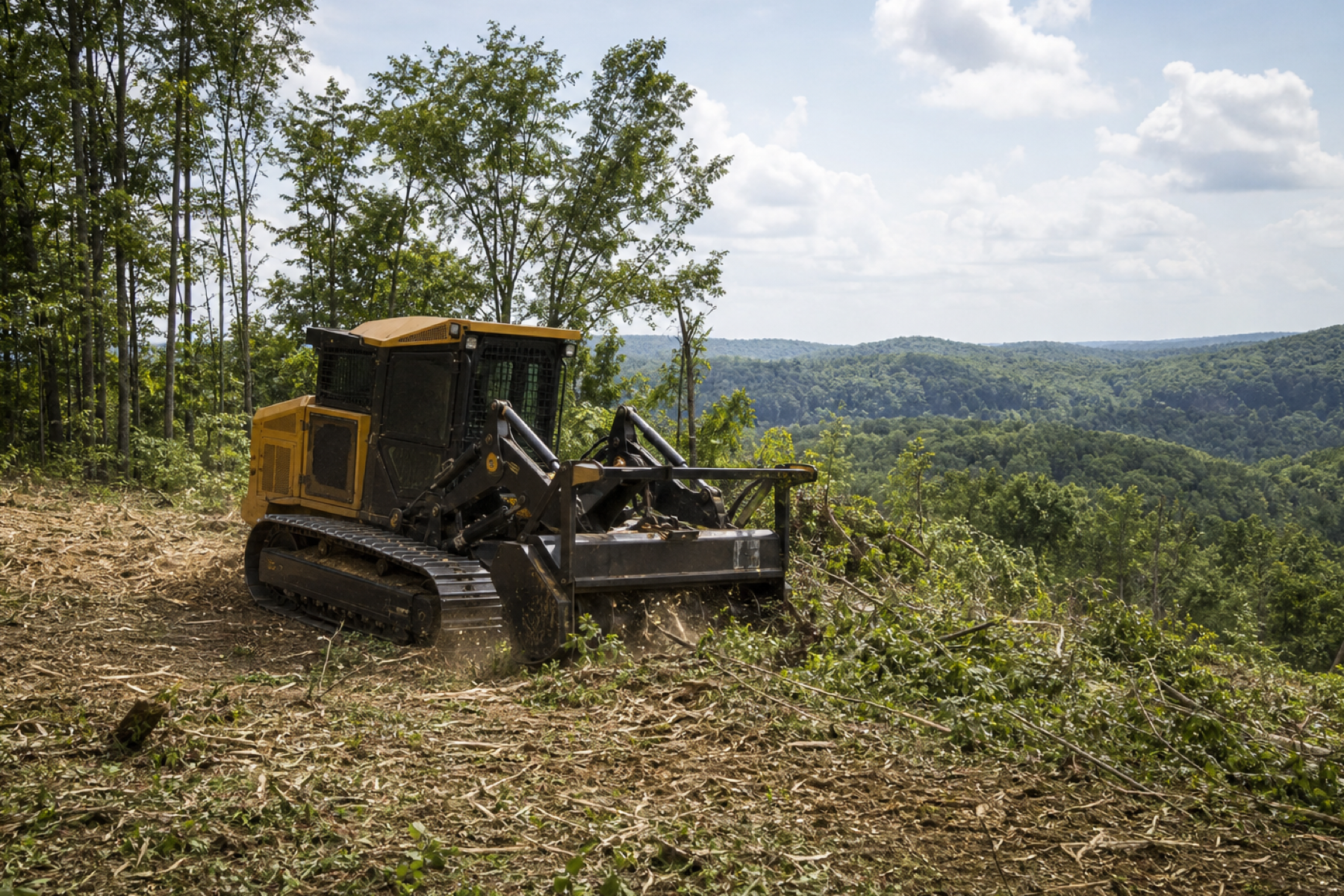
"Cost per acre" is the way most people think about land clearing, so it's worth understanding what actually sits behind that number. The per-acre cost isn't a fixed rate — it's the output of the conditions on your specific acre, and those conditions can swing the figure several times over.
This guide breaks down each factor so you can look at your own property and get a rough sense of where it falls, and so you can describe it accurately when requesting an estimate.
Vegetation Density
Density is the single biggest per-acre variable. An acre of open pasture with scattered saplings clears quickly; an acre of dense, tangled brush, briars, and closely spaced small trees can take many times longer for a machine to process. Production rate — how much ground a machine covers per hour — is what density really affects, and slower production means higher cost per acre.
Tree Size and Species
There's a large gap between clearing saplings and clearing mature timber. Small stems a forestry mulcher shreds in one pass become, at larger diameters, trees that must be felled, cut up, and handled — a different machine and a different pace. Dense hardwoods are tougher and slower to process than soft, young growth, so the size and mix of what's standing changes the per-acre figure substantially.
Terrain, Rock, and Soil
Flat, dry, stable ground lets machines work at full production. Slopes slow everything down and can rule out certain equipment for safety. Rock at or near the surface — common across the Cumberland Plateau — limits anything that works below grade, like stump removal and grading. Soft or wet ground can halt heavy equipment entirely until it dries. Each of these reduces the acres a crew can clear in a day.
Access and Debris Handling
- Access — a narrow gate, low branches over the entrance, or a long haul from the road to the work area all add time and can limit equipment choice.
- Stumps and roots — grinding or grubbing them out is a separate operation from surface clearing and adds meaningfully to per-acre cost when construction requires it.
- Debris — mulching in place leaves nothing to remove and is usually most economical per acre; piling, burning where permitted, or hauling off-site each add handling cost.
- Finished condition — the more 'finished' the acre must be (from knocked-back brush up to a graded pad), the more the per-acre cost climbs.
Why the Same Acre Can Be Priced Two Ways
Because so much depends on the finished condition and method, the same acre can carry very different costs depending on your goal. Mulching that acre for pasture recovery is one price; clearing, grubbing, and rough-grading it for a building pad is another. Deciding what the land actually needs to become is the first step to understanding its per-acre cost — and it's worth discussing with the contractor rather than assuming the most expensive version.
Helpful Guides
This guide is general information for property owners and does not replace an on-site evaluation. Upper Cumberland Land Clearing is an independent referral service; project scope, methods, equipment, pricing and scheduling are determined by the contractor who reviews your property.
Land-Clearing Costs Questions
Online per-acre figures are averages across every kind of job and region. Yours will differ based on your vegetation density, tree size, terrain, access, whether stumps come out, and how debris is handled. A property-specific review is the only way to a number that reflects your acre.
Sometimes modestly, because mobilizing equipment has fixed costs that spread across a larger job. But density, tree size, and terrain still dominate — a large easy job can be cheaper per acre than a small hard one, which is why small projects often cost more per acre.
Usually in-place forestry mulching of brush and small trees, leaving stumps, with no debris hauled off. The more you add — stump removal, grading, debris hauling, a finished pad — the higher the per-acre cost climbs.
Yes, meaningfully, when the land use allows it. Removing stumps and roots is a separate below-grade operation. If the ground is headed for pasture, trails, or similar uses, leaving stumps avoids that phase; construction areas generally can't.
Ready to Turn Overgrown Land Into Usable Property?
Share your contact details and you’ll be contacted to discuss where the property is, how much land is involved and what needs to be cleared.