Property Conditions
How Rocky Ground Affects Land Clearing
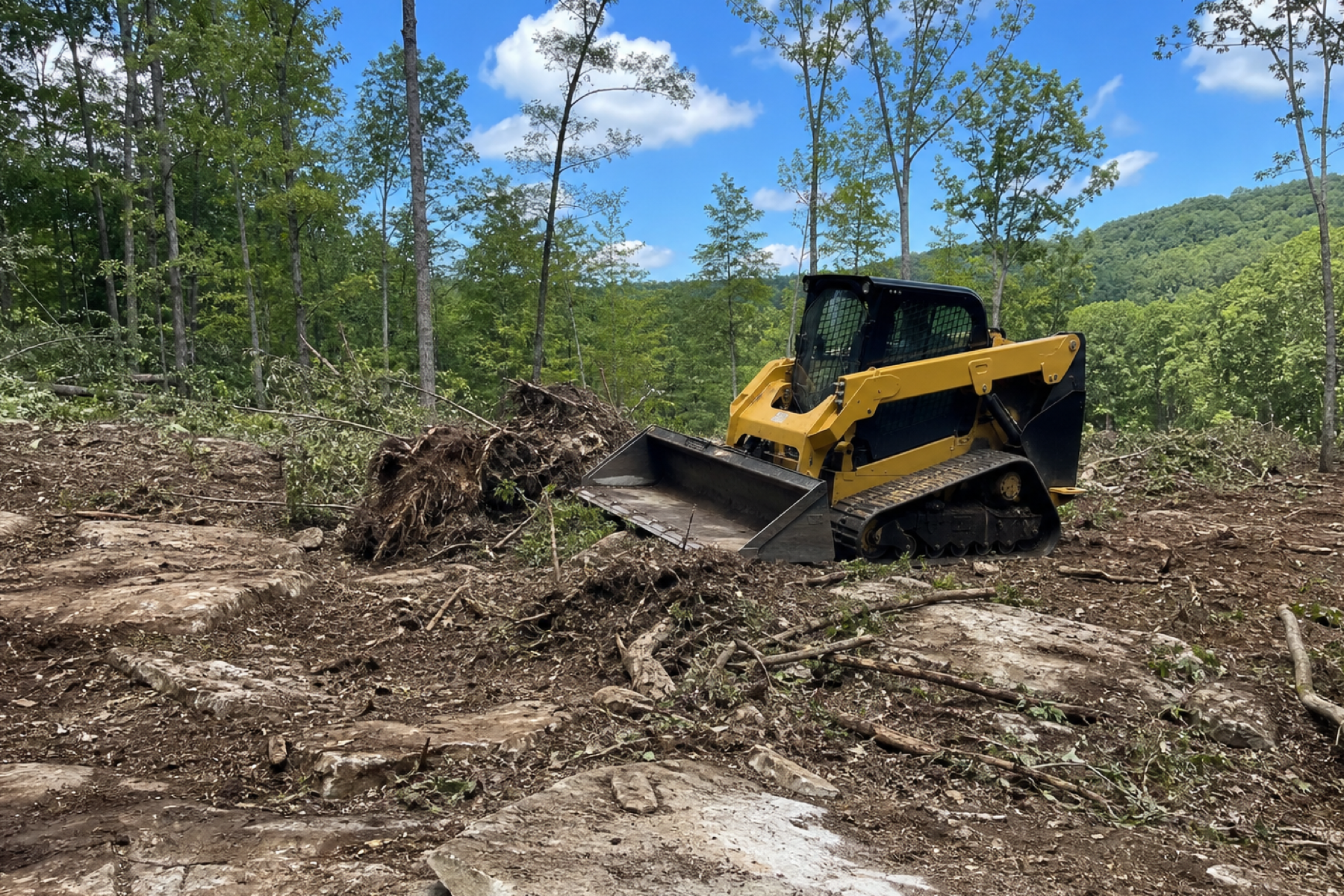
Rock is a defining feature of land across much of the Upper Cumberland — sandstone at or near the surface is common around the Cumberland Plateau, and it changes what's realistic in a clearing project. Above the surface, rock has little effect; below it, it governs everything.
This guide explains how rocky ground shapes clearing methods, stump removal, and grading, so you can set realistic expectations for a property where the rock is close to the top.
Surface Clearing Usually Isn't the Problem
Here's the good news: rock rarely gets in the way of surface clearing. Forestry mulching and brush cutting work on the vegetation above the ground, so they proceed on rocky ground much as they would anywhere — the mulcher grinds brush and saplings regardless of what's beneath. If your goal is opening up overgrown ground and leaving the surface as-is, rock is a minor factor.
Below the Surface Is Where Rock Governs
The moment a project needs to go below grade, rock takes over the conversation. Stump and root removal, excavation, trenching, and grading all depend on being able to work the soil — and shallow rock limits or stops that. A stump wrapped around or sitting on sandstone can't simply be pulled; grading to a specific depth may hit rock that has to be worked around or, in some cases, broken.
This is why two properties with identical vegetation can have very different scopes: the one with rock a foot down and the one with deep soil are the same to mulch but completely different to grub and grade.
What Rock Means for Your Project
- Mulching and brush clearing: largely unaffected — good news for reclaiming overgrown ground.
- Stump removal: harder or limited where roots are in or on rock; grinding may be the practical option.
- Grading and pads: shallow rock can constrain how a site is shaped and may require working around it.
- Drainage and trenching: rock affects where and how deep lines can go.
- Realistic expectations: a build site on shallow rock may need design choices that account for it.
Planning Around It
The key with rocky ground is knowing what you're dealing with before committing to a below-grade plan. A contractor evaluating the property can read the signs — outcrops, shallow soil, the lay of the land — and advise on what's realistic. Sometimes the answer is adjusting the plan (mulch and leave stumps, place the pad where soil is deeper) rather than fighting the rock.
If you're considering a building site on Plateau ground, our site-preparation guides cover how clearing, grubbing, and grading interact, and why the rock question is best answered early.
Helpful Guides
This guide is general information for property owners and does not replace an on-site evaluation. Upper Cumberland Land Clearing is an independent referral service; project scope, methods, equipment, pricing and scheduling are determined by the contractor who reviews your property.
Property Conditions Questions
Not for surface clearing — mulching and brush cutting work on vegetation above ground and proceed normally on rocky sites. Rock becomes a factor only when a project needs to go below grade, such as stump removal, grading, or excavation.
Sometimes, but it's harder and occasionally impractical where roots are wrapped around or sitting on rock. Grinding the stump down may be the realistic option instead of full removal. A contractor assesses this per stump and site.
It can. Shallow rock constrains grading depth, drainage, and excavation, so a pad or driveway may need to be placed or designed around it. Knowing where the rock is before finalizing the site plan avoids costly surprises.
Yes — sandstone at or near the surface is characteristic of the Cumberland Plateau. It's a normal condition contractors here plan around, especially for below-grade work like grubbing and grading.
Ready to Turn Overgrown Land Into Usable Property?
Share your contact details and you’ll be contacted to discuss where the property is, how much land is involved and what needs to be cleared.