Site Preparation
Why Stumps and Roots Must Be Removed From Building Areas
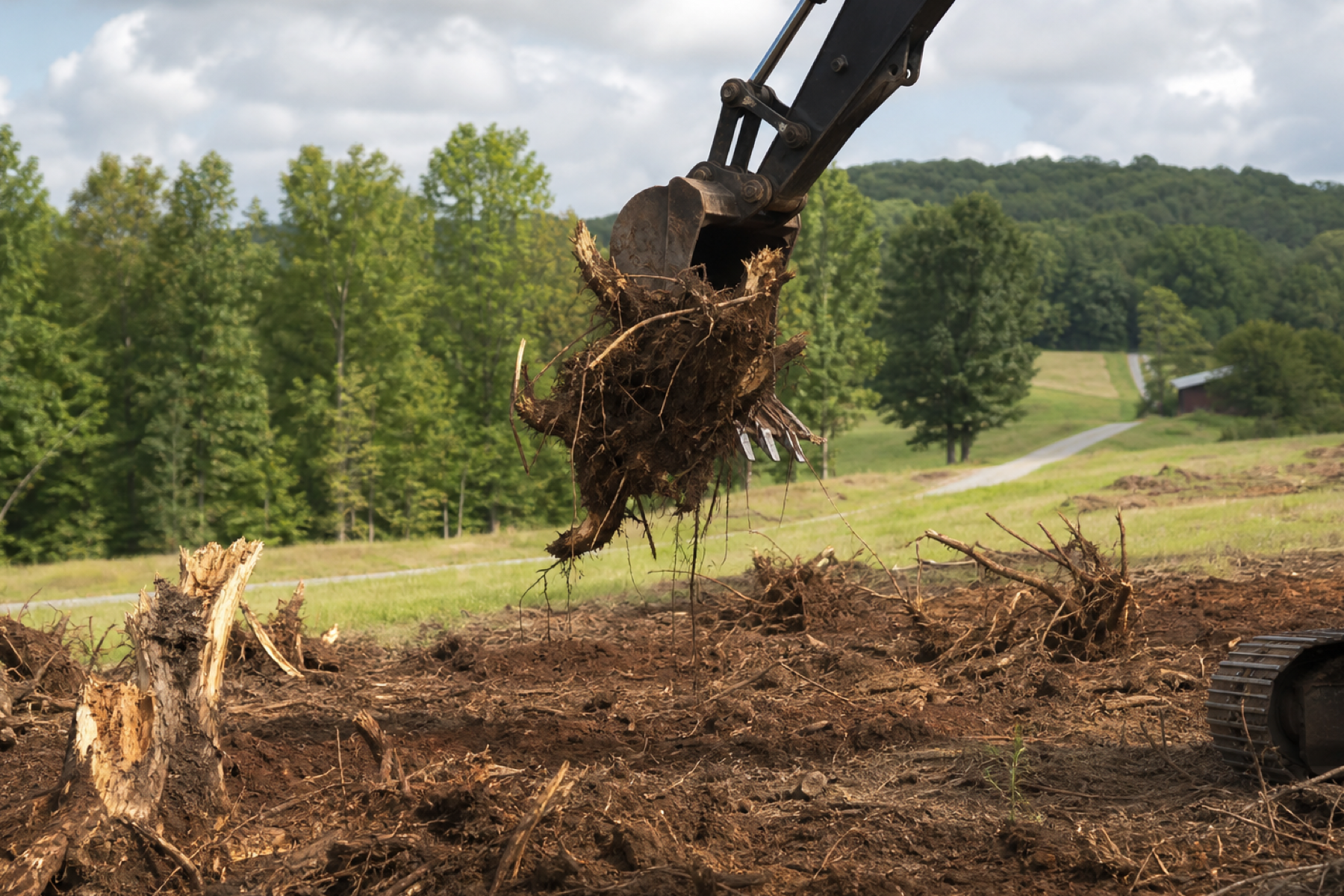
For a lot of clearing projects, leaving stumps in the ground is perfectly fine — pasture, trails, and open woods don't care. Building areas are the exception, and it's not a minor preference: stumps and roots left under a structure cause real, expensive problems down the road. Understanding why makes it clear this is one step you don't skip.
Organic Material Doesn't Last
The core issue is simple: wood rots. A stump or root system left in the ground is organic material that decomposes over the following years. As it breaks down, it loses volume and the soil around and above it loses its support. Under a lawn, that just means a small depression. Under a foundation, slab, or driveway, it means the ground beneath your structure is slowly changing — and not in your favor.
Voids and Settling
- As roots decay, they leave voids — empty spaces the soil above eventually collapses into.
- That collapse is uneven, so different parts of a slab or foundation settle by different amounts.
- Uneven settling is what cracks slabs, foundations, and driveways and racks door and window frames.
- The damage shows up months or years later — after the concrete is poured and hard to fix.
Why You Can't Just Grind Them
Grinding a stump down below grade is enough for a lawn, but not for a building area, because grinding leaves the root system in the ground — and it's the roots decaying that cause the settling. Building areas need the stump and its major roots removed (grubbed out), not just the visible stump ground down. Our guide on stump grinding versus stump removal covers this distinction, and what grubbing is covers the operation itself.
Cheaper Now Than Later
Grubbing a footprint adds cost to the clearing project, and it's tempting to skip to save money. But it's far cheaper to remove stumps and roots before building than to deal with a settling foundation or cracked slab afterward — repairs that can dwarf the grubbing cost and are disruptive to fix under a finished structure. This is the classic case where the right prep up front prevents a much bigger bill later. Our guide on land clearing for a new home site puts grubbing in the full site-prep sequence.
Helpful Guides
This guide is general information for property owners and does not replace an on-site evaluation. Upper Cumberland Land Clearing is an independent referral service; project scope, methods, equipment, pricing and scheduling are determined by the contractor who reviews your property.
Site Preparation Questions
Because they're organic material that decays over years, leaving voids and causing uneven settling beneath the structure. That settling cracks slabs, foundations, and driveways and racks door frames — expensive problems that show up after construction. Removing them leaves stable ground.
Not for building areas. Grinding leaves the root system in the ground, and it's the decaying roots that cause settling. Building footprints need the stump and its major roots grubbed out, not just the visible stump ground down.
As the wood decays, it creates voids and uneven settling under the structure, leading to cracked slabs and foundations, shifting, and misaligned doors and windows — usually months or years later, when it's difficult and costly to repair beneath a finished building.
No — only from building areas and other load-bearing or graded zones. For pasture, trails, and open ground, stumps can usually be left at ground level. Grubbing is targeted to where structures, driveways, or grading require stable soil.
Ready to Turn Overgrown Land Into Usable Property?
Share your contact details and you’ll be contacted to discuss where the property is, how much land is involved and what needs to be cleared.