Site Preparation
Clearing Land for a Driveway
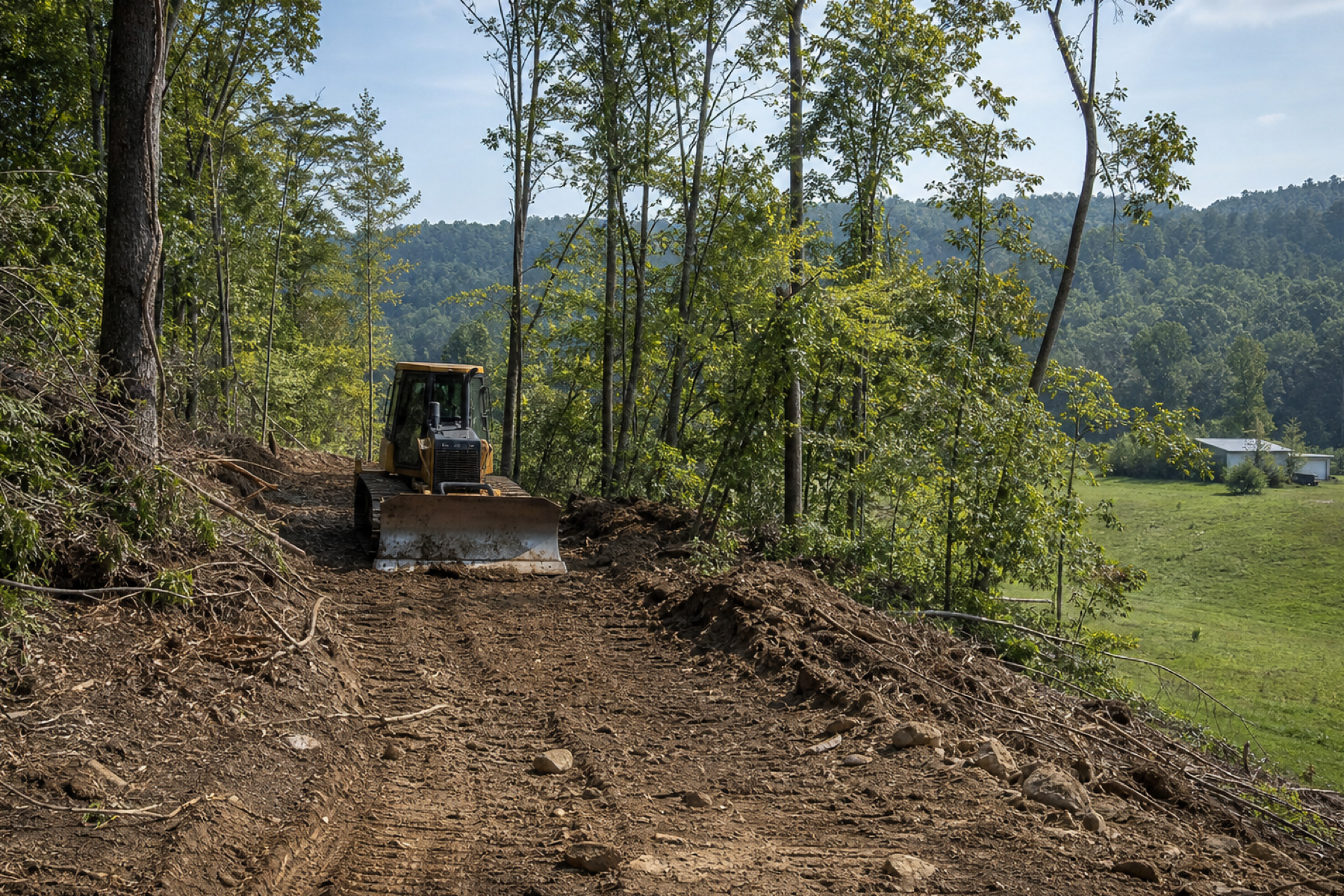
A driveway is often the first project on a rural or wooded lot — you can't build, or even easily work, what you can't reach. But clearing a driveway is more than knocking down a line of trees: a driveway that lasts needs the right width, stumps and roots removed, proper grading, and — most of all — drainage. Skimp on any of those and you get a path that washes out or won't support vehicles.
This guide covers what clearing land for a driveway actually involves so the result is durable, not just passable.
More Than a Cleared Path
It's tempting to think of a driveway as simply 'clear a lane through the trees,' but a surface that carries vehicles day after day, through Tennessee's wet seasons, needs to be built, not just opened. The clearing is the first step; what turns a cleared corridor into a driveway is the below-grade and surface work that follows.
Width and Corridor
- Clear wider than the driving surface — room for the road, shoulders, drainage, and equipment access during construction.
- Account for overhead clearance — trees and limbs above the corridor, not just beside it.
- Consider turns and grades — vehicles (including delivery and emergency) need workable angles and slopes.
- Plan for maintenance access along the corridor to keep it clear over time.
Grubbing, Grading, and Drainage
A driveway is a load-bearing surface, so the same rules as a building pad apply. Stumps and roots must be grubbed out of the driving surface — left in place, they decay and create soft spots and settling. The corridor is then graded to a stable, properly sloped surface. And drainage is the make-or-break element: a driveway that doesn't shed water will rut, wash, and fail. Culverts at low crossings, ditching along the sides, and a crown or slope that moves water off the surface are what separate a driveway that lasts from one that becomes a seasonal problem.
Getting It Right the First Time
Because a driveway ties together clearing, grubbing, grading, and drainage, it's worth planning as the integrated project it is rather than a quick clearing job. Think about where it starts and ends, the grades it has to climb, where water crosses it, and how heavy the traffic will be. Getting the drainage and base right up front is far cheaper than rebuilding a failed drive later. Describe the route, the terrain, and the intended use when you request a review, and see our guides on clearing versus grading and grubbing for how the stages fit.
Helpful Guides
This guide is general information for property owners and does not replace an on-site evaluation. Upper Cumberland Land Clearing is an independent referral service; project scope, methods, equipment, pricing and scheduling are determined by the contractor who reviews your property.
Site Preparation Questions
More than clearing a path: clearing the corridor (wider than the driving surface), grubbing stumps and roots out of the driving area, grading a stable sloped surface, and building drainage — culverts, ditching, and a crown or slope to shed water. Those last steps are what make a driveway durable.
Because a driveway is a load-bearing surface. Stumps and roots left in the driving area decay over time, creating soft spots, settling, and ruts. Grubbing them out leaves stable ground that supports vehicles, just like a building pad.
Wider than the driving surface itself — to allow for shoulders, drainage ditches, equipment access during construction, and overhead clearance. The exact width depends on the vehicles it serves and the terrain, which a contractor can advise on.
Because water is what destroys driveways. Without drainage — culverts at crossings, side ditching, and a surface that sheds water — a drive ruts, washes out, and fails, especially through wet Tennessee seasons. Getting drainage right up front is far cheaper than rebuilding later.
Ready to Turn Overgrown Land Into Usable Property?
Share your contact details and you’ll be contacted to discuss where the property is, how much land is involved and what needs to be cleared.