Property Conditions
Can Forestry Mulching Be Used on Steep Land?
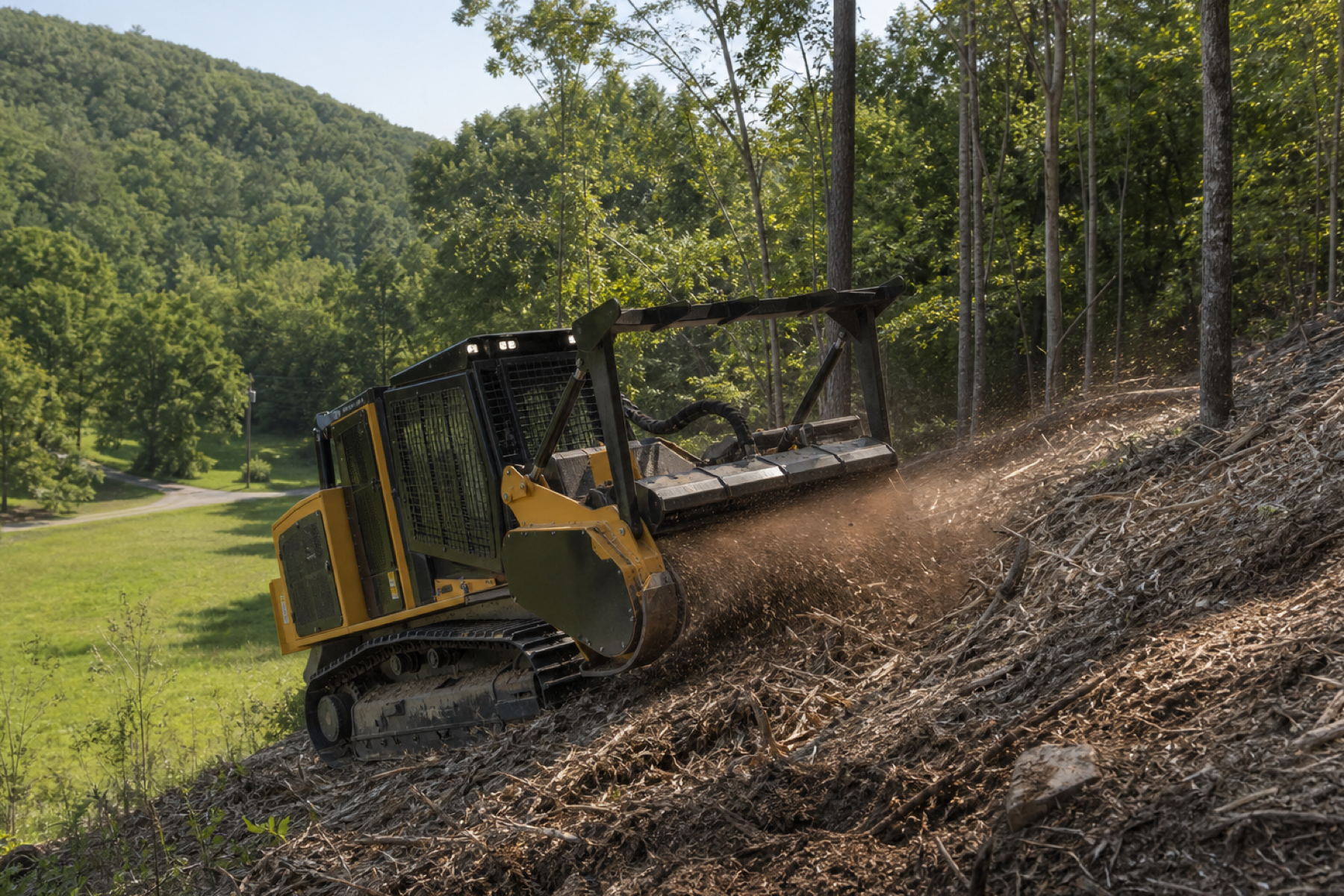
Much of the Upper Cumberland is anything but flat, so it's a fair and common question: can forestry mulching handle sloped ground? The short answer is that mulching often manages slopes better than other clearing methods — but steepness has real limits, and safety sets them.
This guide explains how slope affects mulching, where the practical limits fall, and why a contractor's on-site judgment is what determines whether a hillside can be worked.
Why Mulching Handles Slopes Well
Forestry mulchers are typically tracked machines with a low center of gravity, which gives them better stability and traction on grade than wheeled equipment. Because mulching works the vegetation top-down in place — without pushing, piling, or hauling material across the slope — it disturbs the ground less and avoids some of the instability that traditional clearing can create on hillsides. For moderately sloped, wooded Tennessee ground, mulching is frequently the most practical method.
Where the Limits Are
Every machine has a safe working limit, and slope is where it's reached. Past a certain steepness, operating becomes unsafe regardless of the equipment, and no responsible contractor will work ground that risks a rollover or loss of control. The exact limit depends on the specific machine, the ground conditions (dry versus wet, firm versus loose), and the operator's judgment. Wet ground dramatically lowers what's safe on a slope, since traction drops.
What Slope Means for Your Project
- Moderate slopes — usually workable with mulching, at a somewhat slower production rate than flat ground.
- Steep slopes — may be workable with the right machine in dry conditions, or may be beyond safe limits.
- Very steep or unstable ground — likely can't be safely worked by machine at all.
- Wet slopes — significantly more limited than the same slope when dry, due to reduced traction.
Only an On-Site Look Can Say for Sure
Because the safe limit depends on the specific slope, the ground, the equipment, and conditions on the day, whether a hillside can be mulched is a judgment a contractor makes in person. Photos and a description help scope it, but steep ground in particular benefits from an on-the-ground evaluation. When you request a review, note the slope honestly and include photos that show the grade — and understand that safety, not willingness, sets the boundary. Our guide on how terrain affects cost covers the pricing side of sloped work.
Helpful Guides
This guide is general information for property owners and does not replace an on-site evaluation. Upper Cumberland Land Clearing is an independent referral service; project scope, methods, equipment, pricing and scheduling are determined by the contractor who reviews your property.
Property Conditions Questions
Often yes — tracked mulchers handle moderate slopes better than most methods because of their stability and low-impact, in-place operation. But steepness has limits set by safety, so very steep or unstable ground may be beyond what can be worked.
There's no single number — it depends on the specific machine, whether the ground is dry and firm or wet and loose, and the operator's judgment. The safe limit is determined on-site, and no responsible contractor works ground that risks a rollover.
Significantly. Wet ground reduces traction, so a slope that's workable when dry may be unsafe when wet. Steep, wet ground is where projects most often have to wait for drier conditions.
Request a review with honest notes on the steepness and photos that show the grade. Steep ground especially benefits from an on-site look, since the safe working limit depends on the specific slope, conditions, and equipment.
Ready to Turn Overgrown Land Into Usable Property?
Share your contact details and you’ll be contacted to discuss where the property is, how much land is involved and what needs to be cleared.